

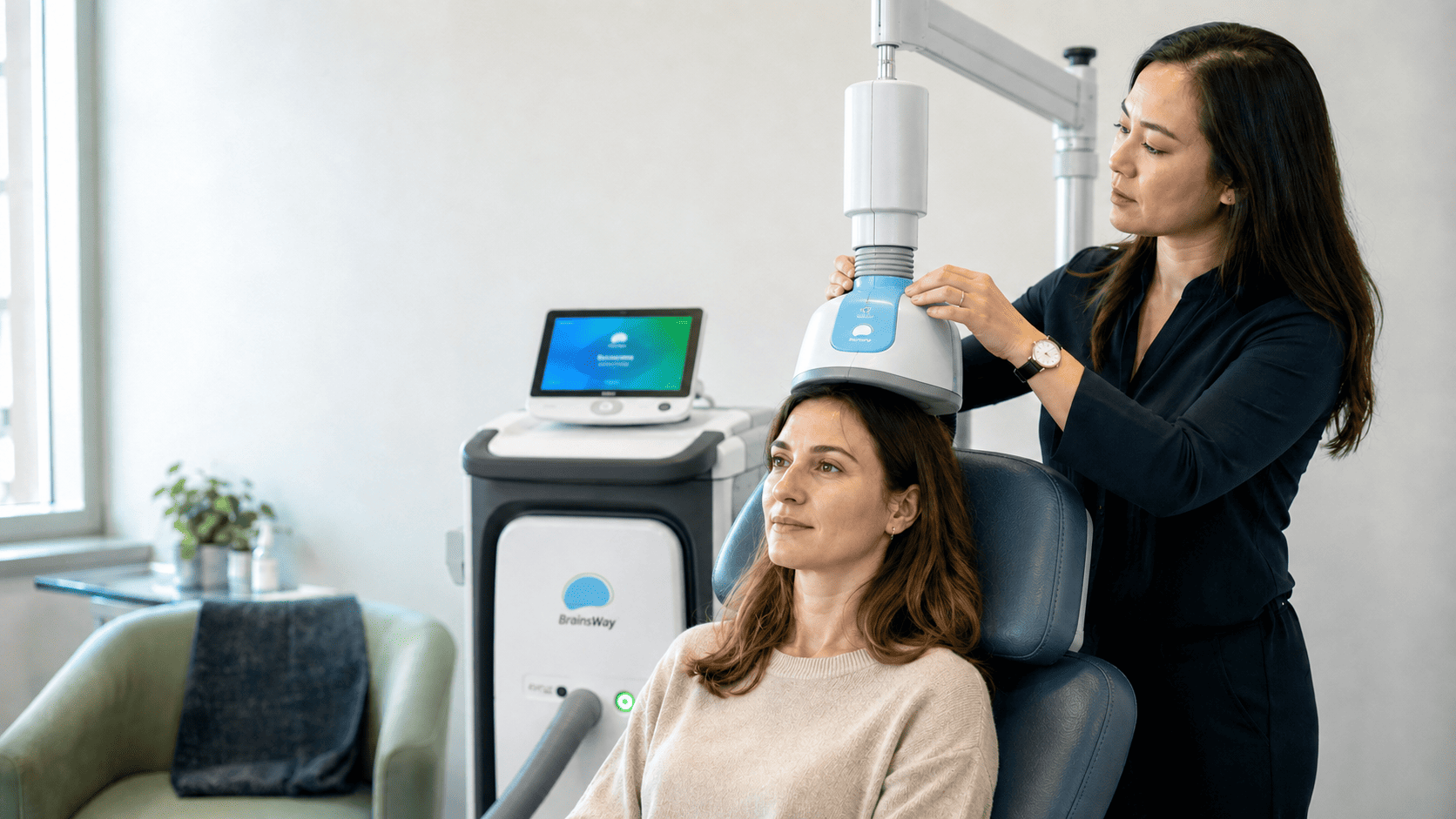
TMS progress often shows up gradually, not as one sudden change. You may notice shifts in mood, sleep, energy, focus, or daily functioning before the improvement becomes more consistent. Clinical studies on TMS trajectory show that while early physiological shifts can begin in the first two weeks (sessions 5-10), significant symptom reduction typically becomes measurable between sessions 10 and 20. At York TMS Clinic, treatment progress is tracked with these patterns in mind. Keep reading to learn what signs to watch for and how progress is assessed.
Key Takeaways
- Early TMS changes can be subtle
- Track trends, not single-day changes
- Clinical tracking adds valuable context
What Are the Early Signs TMS Is Starting to Work?
Recovery with TMS is an incremental process. Patients frequently report initial changes in somatic functions, such as improved sleep quality or reduced emotional effort for daily tasks, before a significant mood elevation is consciously felt. Standardized scales like the PHQ-9 and QIDS-SR help clinicians identify these neuroplastic shifts during a typical 36-session protocol.
Clinical observations show that early shifts often occur within the first five sessions, after which progress settles into a steady, incremental pattern. Research from the National Library of Medicine indicates that neurophysiological changes often precede conscious mood elevation. So even before someone feels a major shift, real progress can already be happening underneath.
Early signs to watch for:
- Sleeping through the night more consistently
- Having a little extra energy during the daytime
- Experiencing sadness as lighter and less constant
- Noticing fewer repetitive, negative thought loops
- Feeling more capable of handling everyday chores
- Experiencing more stable stretches throughout the week
Not everyone improves in the same order. Some people notice that sleep gets better first, while for others, mood or motivation catches up later. That is normal, and an early response pattern does not limit your final outcome.
When administering BrainsWay Deep TMS, we utilize its unique H-Coil architecture to target neural networks involved in depression and OCD. Expectations are based on the device’s FDA-cleared indications. In BrainsWay’s FDA pivotal study for OCD, 38.1% of patients in the active treatment group achieved a clinical response compared to 11.1% in the sham group.
How Clinicians Measure Progress
Clinicians use objective metrics and functional assessments to track progress beyond subjective feelings. This standardized approach ensures that treatment is evaluated based on clinical evidence and daily-life improvements.
Why Sleep and Energy Improve Before Major Mood Changes?
Sleep and physical energy often improve early in treatment because different brain functions recover at different speeds. Cognitive and somatic (physical) symptoms frequently begin to lift before deep emotional changes take full effect.
Treatment Integration and Safety Considerations
Progress during TMS is best evaluated as part of a comprehensive care plan, which may continue to include psychotherapy or medication when appropriate.
- Non-Invasive Protocol: TMS requires no surgery or anesthesia. Patients remain fully awake during short sessions with no downtime required afterward; these foundational elements are explained in detail on what is TMS therapy.
- Device Safety Guidelines: According to FDA guidelines for devices like BrainsWay Deep TMS, treatment is contraindicated for individuals with non-removable metal or implanted electronic devices in or near the head.
- Medical Review: Patients with a personal or family history of seizures must undergo a thorough medical evaluation prior to starting therapy to ensure treatment safety.
What Changes in Focus and Motivation Can Indicate TMS Progress?

TMS therapy often rewires neural circuits related to executive function before full emotional relief sets in. Recognizing subtle cognitive and behavioral shifts offers a clear picture of early treatment progress.
Subtle Focus and Cognitive Shifts
- Faster Decision-Making: Choosing what to eat or wear takes seconds rather than spiraling into fatigue.
- Sustained Attention: Reading a chapter, tracking conversations, or completing work tasks happens without constant mental drift.
- Reduced Brain Fog: Processing information feels clearer, requiring less conscious effort to stay engaged.
Early Motivation Signals
- Initiating Daily Tasks: Cooking, cleaning, or running errands gets done with significantly less internal resistance.
- Re-engaging in Hobbies: Returning to sports, reading, crafting, or exercising out of genuine interest rather than obligation.
- Social Re-emergence: Texting back promptly, picking up the phone, and keeping scheduled appointments instead of canceling.
Understanding Clinical Benchmarks
Better day-to-day functioning is a strong indicator of progress, but clinical evaluation relies on specific metrics.
| Metric | Definition | Significance |
| Response | ≥ 50% reduction in symptom baseline scores | Marks meaningful clinical improvement |
| Remission | Score drops below threshold (e.g., HDRS ≤ 7) | Represents full functional recovery |
| Functional Shift | Behavioral/cognitive changes | Often precedes measurable scale score drops |
Tracking Progress Effectively
Systematic weekly logging provides actionable insights for clinicians, eliminating reliance on memory alone. Tracking at key treatment intervals, such as sessions 5, 10, 20, 30, and post-treatment, helps identify baseline trends over time.
Essential Weekly Tracking Checklist
- Mood & Emotion: Overall baseline comparison, anxiety level, and irritability patterns.
- Cognitive Function: Focus duration, decision speed, and task completion effort.
- Somatic Indicators: Sleep continuity, morning grogginess, and daytime energy levels.
- Clinical Measures: Standardized score logs (such as the PHQ-9 or HDRS) alongside social engagement frequency.
Daily fluctuations are normal; the primary target is a positive overall trend compared to your starting baseline.
How Long Does It Usually Take to Notice TMS Is Working?
There’s no single timeline. Some people notice a shift in the first couple weeks. For others, response takes longer, TMS therapy in Lancaster, PA is available as an outpatient option. Response timing depends on diagnosis, symptom severity, the specific protocol, and individual neurobiological factors. And an early change doesn’t mean the effect has already peaked, it usually keeps building from there.
A 2025 study that followed 402 patients found measurable improvement by session five, and more improvement kept showing up at later points in treatment. That’s a good reason to track things the whole way through, not just wait for one big “aha” moment.
Here’s a rough sense of what to expect:
| Treatment Stage | What You May Notice | How Progress Is Assessed |
| Early sessions | Subtle changes in sleep, energy, or overall symptoms | Patient observations and clinical check-ins |
| Around Session 5 | Early symptom changes may become measurable | Standardized symptom scales and clinical assessment |
| Sessions 10-20 | More noticeable symptom reduction may develop | Changes in symptom scores and daily functioning |
| Weeks 4-6 | Mood, energy, focus, and motivation may continue improving | Ongoing symptom tracking and clinician review |
| Later treatment | Overall response and possible remission are evaluated | Symptom scores, functioning, treatment response, and clinical assessment |
These are just general ranges, not guarantees. Some people move faster than this. Others need more sessions before anything feels clear.
BrainsWay Deep TMS is evaluated based on its FDA-cleared protocol. Its H-Coil is designed to reach deeper neural networks, and progress is assessed alongside the patient’s comprehensive psychiatric care plan.
At York TMS Clinic, we look at progress alongside whatever psychiatric care someone’s already getting. Medication and therapy can keep going during TMS when that makes sense, so changes get read as part of the whole picture instead of on their own.
A slow start doesn’t mean treatment failed. A clinician can look at symptom scores, day-to-day changes, how consistently someone showed up for sessions, any side effects, and the specific protocol before deciding what the trend actually shows.
How Do Doctors Measure Whether TMS Is Working?
Doctors don’t just ask “do you feel better?” They use tests and track changes over time. This gives a clearer answer than checking in on one random day.
Most clinics use a test called the PHQ-9 to see how bad depression symptoms are. Some studies also use other tests, like the QIDS-SR, MADRS, or HAM-D. These tests let doctors compare how a patient is doing now versus when they started.
Recent clinical cohort studies involving over 400 patients confirm what we observe in daily practice: depressive symptoms respond asynchronously. Executive functions and sleep cycles frequently stabilize sessions before core affective symptoms show measurable drop-offs.
| Assessment Method | What It Measures | Why It Matters |
| PHQ-9 | Severity of depressive symptoms | Provides a standardized way to compare symptoms over time |
| QIDS-SR | Patient-reported depression symptoms | Helps identify changes across individual depressive symptoms |
| Clinical Check-In | Overall symptoms, functioning, and treatment response | Gives the clinician broader context beyond a single score |
| Daily Functioning | Sleep, energy, motivation, focus, and activity | Shows whether symptom changes are affecting everyday life |
| Treatment Notes | Treatment schedule, settings, side effects, and changes over time | Helps clinicians interpret progress within the specific treatment protocol |
Good doctors look at test scores AND real life. A patient’s score might go down, but they could still struggle at work or with people close to them. Both things matter.
At York TMS Clinic, doctors use test scores plus daily life changes to figure out if treatment is going well or if they need to look closer.
Tests also stop people from focusing on just one thing. Sleeping better but mood staying the same could mean things are just starting to turn around. But if mood, energy, and focus are all getting better, that’s a stronger sign.
What’s the Difference Between “Response” and “Remission”?
In a clinical context, “Response” indicates a ≥ 50% reduction in symptoms, whereas “Remission” indicates that symptoms have dropped below a specific clinical threshold. A meta-analysis of rTMS trials noted that approximately 29% of treatment-resistant patients achieved clinical response, though outcomes vary by individual.
Studies usually say “response” means symptoms dropped by a certain percent. The exact number depends on the study. Remission has its own rules too. Ask your doctor which test and which numbers they’re using.
A milestone meta-analysis of high-frequency rTMS trials found that approximately 29% of treatment-resistant patients achieved clinical response and 19% achieved full remission, though modern Deep TMS protocols often report higher real-world outcomes.
| Result | What it means |
| Early improvement | Some symptoms are starting to ease up |
| Response | A big drop in symptoms |
| Remission | Symptoms are almost gone |
| No response | Not much change at all |
Those numbers come from older studies. They don’t predict what will happen for any one person. Results depend on the device used, the treatment plan, and the patient.
This matters for BrainsWay Deep TMS too. It’s cleared for depression, OCD, anxious depression, and smoking addiction. But each of these has its own treatment plan and its own research behind it.
A patient can feel a lot better in daily life without hitting full remission. Regular check-ins with a doctor help track if early progress keeps building.
What If Progress Feels Slow or Hard to Notice?
Progress in mental health treatment rarely moves in a straight line, and when changes happen incrementally, they are remarkably easy to miss. The brain adapts gradually, meaning subtle shifts in energy, sleep, or thought patterns often occur long before a major shift in overall mood becomes obvious.
”Remission was achieved in 41% for depression (HDRS ≤ 7) and 61% for suicidal ideation” – Clinical Neurophysiology
Understanding Your Progress Trajectory
Measuring day-to-day fluctuations usually offers a distorted view, as normal emotional ups and downs obscure real underlying growth. Evaluating changes across longer windows reveals patterns that daily check-ins miss.
Key Indicators of Gradual Improvement
- Emotional Resilience: Rough days become shorter, and negative thought loops lose their intensity faster.
- Physical & Functional Shifts: Mornings require less effort, daily chores feel manageable, and sleep quality stabilizes.
- Pattern Changes: Good days begin to outnumber severe ones over a full month, even if bad days still occur.
The 2025 PubMed trajectory research on TMS highlights that symptom recovery is non-linear; functional gains (like improved activity or sleep) frequently precede emotional relief by several weeks.
Knowing When to Adjust Your Plan
While patience is essential, tracking your baseline remains critical. If several check-ins pass with zero observable shifts across any symptom category, bring this data directly to your healthcare provider to discuss potential adjustments.
What Should You Do If You Do Not Notice Improvement From TMS?

If you are not seeing progress during Transcranial Magnetic Stimulation (TMS), do not try to figure out why on your own. Talk directly to your treatment team. They can evaluate your symptom scores, check treatment settings, review your diagnosis, and determine whether you remain among the right candidates for BrainsWay Deep therapy in York, while also considering session adherence, concurrent medications, and daily life factors.
Even a stall in progress gives your doctor useful data. Your team can compare your current scores to your baseline to see if your progress aligns with typical treatment trajectories.
A comprehensive network meta-analysis of over 140 clinical trials involving 10,500+ patients found clear differences among rTMS approaches, along with areas of remaining uncertainty (PubMed systematic review and network meta-analysis). That is why treatment plans must be tailored to your specific situation rather than relying on a general rule.
What Your Care Team Evaluates During Progress Reviews?
When reviewing your progress, your care team systematically examines several core areas to figure out why your response might be lagging and how to adjust your care plan:
Clinical Metrics & Symptom Tracking
- PHQ-9 or Hamilton Scores: Comparing your current symptom ratings against your baseline measurements to spot subtle trends.
- Overall Symptom Shifts: Evaluating how much your total depression or anxiety severity has changed since session one.
- New or Worsening Symptoms: Identifying any emerging side effects, increased distress, or concerning shifts in mood.
Functional & Daily Improvements
- Core Biological Markers: Checking for early progress in sleep patterns, daily energy levels, mental focus, and motivation.
- Everyday Functioning: Seeing if you are finding it easier to manage daily tasks, work, or personal relationships.
Protocol & Lifestyle Factors
- Treatment Adherence & Settings: Reviewing your exact schedule, session consistency, coil placement, and motor threshold settings.
- External Variable Changes: Accounting for recent adjustments to your medications, psychotherapy routines, or major life stressors.
At York TMS Clinic, doctors go through these exact factors as part of a personalized evaluation for every patient. The clinic offers FDA-cleared BrainsWay Deep TMS as one option within a broader approach to psychiatric care.
Deep TMS is not right for everyone. It is unsafe for individuals with certain metal implants in or near the head, such as some cochlear implants or deep brain stimulators, and people with a history of severe seizures require careful screening before proceeding.
What Signs Should You Track During TMS Treatment?

Keeping track of your mood, sleep, energy, focus, anxiety, motivation, and daily activities can help you notice progress that might otherwise be easy to miss. The best way to do this is to check the same things, the same way, week after week.
A simple weekly log works well. Rate how bad each symptom feels on a scale of 0 to 10, and jot down real examples too. Saying “my energy is better” is fine, but saying “I got out of bed earlier and made breakfast four days this week” gives your doctor a lot more to work with.
Research from the National Library of Medicine shows:
”dTMS changes neurophysiological states which has a clinical counterpart” – National Library of Medicine
The National Institute of Mental Health says to get professional help when symptoms start getting in the way of daily life or causing real distress, not to just track things yourself and wait it out. (National Institute of Mental Health)
Here’s a simple way to track your progress:
- Mood: sadness, hopelessness, how stable you feel
- Sleep: how long it takes to fall asleep, waking up at night, how rested you feel in the morning
- Energy: tiredness and how active you are during the day
- Focus: reading, conversations, work, making decisions
- Motivation: starting and finishing tasks
- Anxiety: how strong and how often
- Function: hygiene, meals, work, exercise, errands
- Social life: talking to people and spending time with others
A 2025 study checked patients’ depression symptoms at six different points during treatment. It’s a good example of how checking in regularly can catch patterns that you’d miss with just one check-up.
Your log doesn’t need to be fancy. Being consistent matters more than being detailed. Your doctor can help you figure out which official rating tool makes sense for tracking your specific treatment.
What Should You Remember About Signs That TMS Is Working?
If you’re tracking TMS progress, don’t let one good day or one difficult day decide whether treatment is helping. Look for steady changes in symptoms and daily functioning, then discuss those changes with your clinician. Small improvements in sleep, energy, focus, or motivation can appear before a bigger mood change.
The next step is simple, keep a weekly record and bring it to your appointments. York TMS Clinic provides FDA-cleared BrainsWay Deep TMS for eligible patients, with treatment tailored to the broader care plan. If you’re considering TMS or want to review whether your current progress supports another step, visit York TMS Clinic to learn more and explore your options.
FAQs
What are the signs TMS is starting to work?
The signs TMS is starting to work may include better sleep, more energy, improved mood, less rumination, better concentration, and greater ability to complete daily activities.
These changes can occur gradually rather than simultaneously. A sustained pattern across several days or weeks is more useful than one unusually positive day.
How do you know if TMS is working?
You can know whether TMS appears to be working by comparing symptom scores and daily functioning with the treatment baseline under clinical supervision.
The PHQ-9, QIDS-SR, MADRS, or another validated measure can provide structured information. Daily observations about sleep, energy, motivation, and activity can add functional context.
What are early signs of TMS response?
Early signs of TMS response can include subtle improvements in sleep, energy, concentration, emotional stability, and willingness to complete ordinary tasks.
Clinical trajectory research shows that while subtle early shifts can begin in the first two weeks, measurable symptom reduction typically builds between sessions 10 and 20.
What are common TMS therapy progress signs?
Common TMS therapy progress signs include fewer severe low-mood periods, improved sleep continuity, steadier energy, less rumination, improved focus, and increased engagement with routine activities.
These observations do not establish remission. A clinician must interpret symptom changes in relation to baseline measurements and the treatment protocol.
Can TMS still be working if there is no dramatic change?
Yes, TMS may be producing gradual improvement even when there is no dramatic change, because symptom trajectories can differ across individuals and depressive symptoms.
Patients should discuss limited or worsening improvement with their treatment team rather than deciding independently that treatment has failed. York TMS Clinic can evaluate progress in the context of the prescribed BrainsWay Deep TMS protocol and the patient’s broader treatment plan.
References
- https://pubmed.ncbi.nlm.nih.gov/40803087/#1
- https://pmc.ncbi.nlm.nih.gov/articles/PMC11743562/#1